

Back pain is so common that almost nothing about it is alarming. Four in five adults have it at some point, the great majority of episodes settle, and treating every case as potentially sinister would be both wrong and unkind.
Spinal infection is the rare exception, and it is missed for weeks or months with depressing regularity — not because it is hard to detect, but because it is not looked for. The features that should prompt looking are specific and worth knowing.
How an infection reaches the spine
Usually through the bloodstream. Bacteria from a skin infection, a urinary infection, a dental abscess, an infected line or an injection settle in the spine, where the blood supply to the vertebrae and the discs between them makes a hospitable landing site.
Less often it follows spinal surgery or an injection directly into the spine. Our articles on surgical site infection and dental infections that spread cover two of the sources.
What separates it from ordinary back pain

| Ordinary back pain | Worth investigating | |
|---|---|---|
| What eases it | Rest, position, time | Nothing reliably |
| At night | Usually better lying down | Wakes you, or is worse at night |
| Over weeks | Improving | Steadily worsening |
| Fever | Absent | Present, or came and went |
| Tenderness | Diffuse, muscular | Focal — one spot that hurts to press |
| Recent history | Lifting, a twist, nothing | Infection elsewhere, surgery, a line, or injecting drugs |
| Neurological signs | None | Weakness, numbness, bladder or bowel change |
New weakness in the legs, numbness around the groin, or loss of bladder or bowel control is an emergency whatever the cause. That combination needs the emergency department the same hour, not an appointment.
Fever is present in only about half of spinal infections, which is the single most common reason they are dismissed. Its absence proves nothing.
Where in the spine, and what that changes
Most spinal infections settle in the lower back, some in the mid-back, and a minority in the neck. Location matters because it determines what is at risk if the infection expands.
- The lumbar spine is the commonest site and the least immediately dangerous
- Thoracic infection sits where the spinal canal is narrowest, so pressure develops sooner
- Cervical infection is uncommon and the most urgent of the three
- An epidural abscess — pus in the space around the cord — is the complication that turns this into an emergency
- More than one level is affected in a significant minority, which is one reason the whole spine is often imaged rather than one region
Who is more likely to get one
- Diabetes, which is the commonest associated condition
- Injecting drug use
- Recent bloodstream infection, or infected heart valve
- Dialysis, or a long-term intravenous line; see outpatient IV antibiotics
- Immune suppression, including a biologic or steroids
- Recent spinal surgery or spinal injection
- Older age, and existing spinal degeneration
That said, a meaningful minority of cases occur in people with none of these, which is why the pattern of the pain matters more than the risk profile.
How it is confirmed
- Inflammatory markers, which are raised in most cases; see what CRP and ESR mean
- Blood cultures, which identify the organism in roughly half of cases
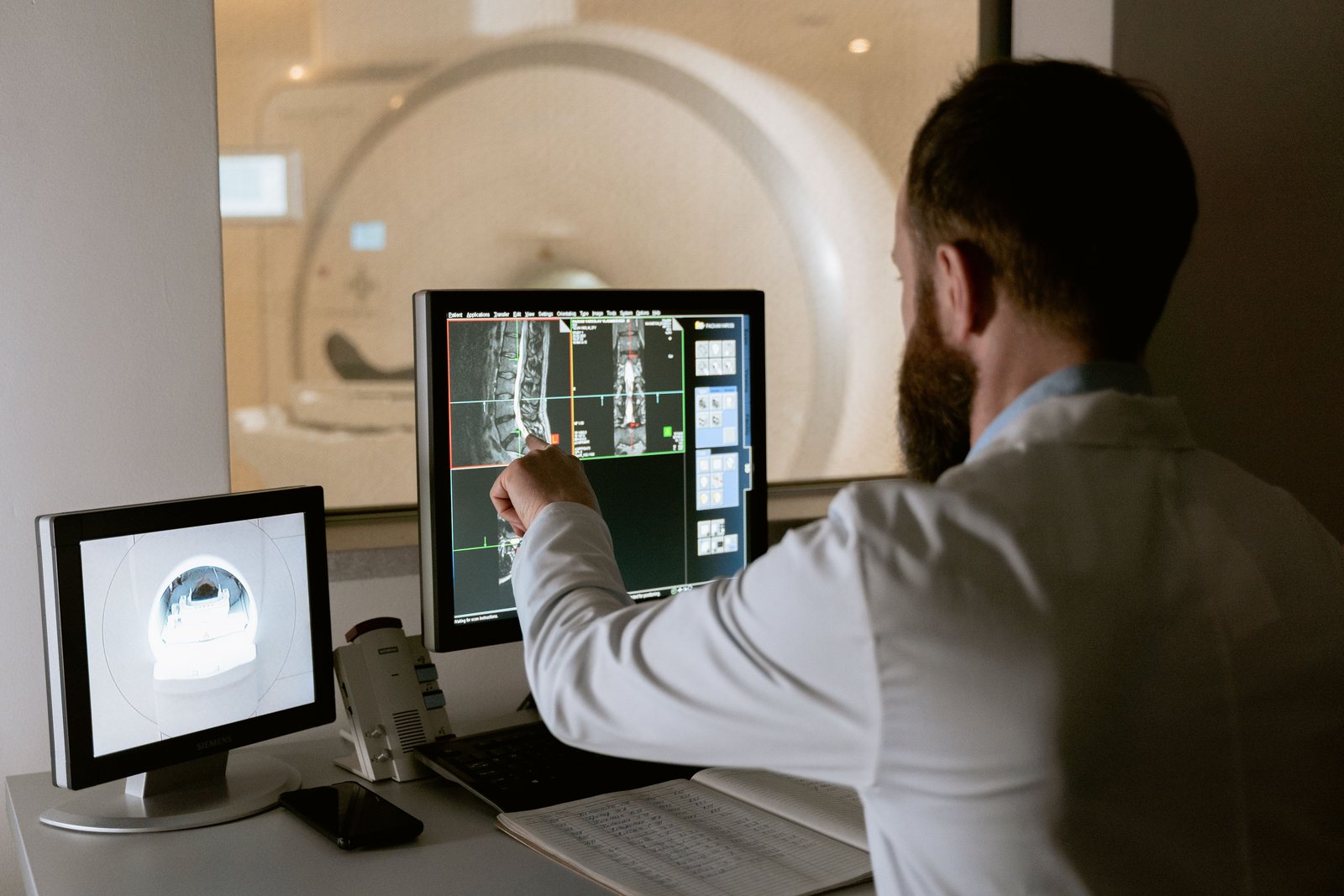
- MRI of the affected region, which is the definitive test
- Plain X-rays, which are often normal for the first two to four weeks
- A biopsy of the disc or bone where blood cultures are negative
- A search for the source — heart valve, urine, skin, teeth
As with bone infection in the foot, getting a sample before antibiotics start matters enormously. Our article on culture and sensitivity results explains why a culture taken after treatment has begun so often grows nothing.
What it is mistaken for
Before the diagnosis is made, most people have been given one of a short list of other explanations, all of them reasonable at the time.
- A disc problem, which is by far the commonest initial assessment
- Muscular strain, particularly where there was a lifting incident to blame it on
- Sciatica, where pain radiates down a leg
- A compression fracture in an older person with osteoporosis
- Cancer spread to the spine, which produces a similar pattern and needs the same imaging
- In people who inject drugs, dismissal of the pain altogether, which is a recognized and serious failure
The point is not that those diagnoses are careless. It is that each of them should improve or at least change over a few weeks, and pain that does neither deserves a second look rather than a repeat prescription.
Treatment, and the length of it
Most spinal infections are treated with antibiotics rather than surgery — typically six weeks or more, usually intravenous at first. The reasons are the ones set out in our article on why some courses run for weeks: bone is poorly penetrated, and the infection sits where the blood supply is limited.
Surgery is needed where there is pressure on the spinal cord or nerves, where the spine has become unstable, where a collection needs draining, or where antibiotics are not working. It is a minority of cases rather than the default.

Recovery is slow. Pain typically improves over months rather than weeks, some people are left with residual stiffness or deformity, and inflammatory markers are followed as part of deciding when treatment can stop. Our article on recovering after a serious infection covers the wider picture.
Follow-up continues after the antibiotics stop. Inflammatory markers are rechecked, imaging is often repeated at intervals, and relapse — while uncommon — happens often enough that a return of the original pain is taken seriously rather than assumed to be mechanical.
Why the delay happens, and what shortens it
The average delay between symptoms and diagnosis is measured in weeks to months. It happens because back pain is common, because fever is often absent, and because plain X-rays are normal early — which is falsely reassuring to everyone involved.
- Say clearly if the pain wakes you from sleep
- Say if you have had any infection, procedure or line in the past few months
- Say if there has been fever at any point, even briefly
- Ask whether inflammatory markers have been checked if the pain is not settling
- Ask about MRI rather than a repeat X-ray where the picture is not typical
- Return sooner rather than later if pain is worsening rather than easing
If back pain is not behaving the way back pain usually does, that is worth saying out loud. Our article on when to see an infectious disease specialist covers when an infection opinion helps, and you can reach us through the contact page.
Frequently asked questions
How common is spinal infection?
Rare — a small fraction of a percent of back pain. That rarity is exactly why it is missed: the base rate is so low that it is not considered unless something about the pattern prompts it.
Can you have a spinal infection without a fever?
Yes, and it is common. Fever is present in roughly half of cases. Its absence is one of the main reasons diagnosis is delayed, so it should not be treated as reassuring.
Will an X-ray show it?
Often not for the first few weeks. Plain films lag well behind the disease, and a normal X-ray early on does not exclude infection. MRI is the test that answers the question.
Does it always need surgery?
No. Most cases are treated with antibiotics alone, usually for six weeks or more. Surgery is for pressure on the nerves, instability, a collection needing drainage, or failure of antibiotic treatment.
How long does recovery take?
Longer than the antibiotics. Pain usually improves over months rather than weeks, and some stiffness can persist. Rehabilitation is part of it rather than an afterthought.
Sources and further reading: American Association of Neurological Surgeons — Spinal infections.
This article is general health information, not medical advice, and it cannot account for your own history or medications. Discuss your situation with a qualified clinician before acting on anything you read here.