

Skip to content

Author: Alexandra W. Dretler

  • What Happens at an Infectious Disease Consultation

    What Happens at an Infectious Disease Consultation

    Being referred to an infectious disease specialist worries people more than most referrals. The name sounds alarming, and it is not a specialty most patients have encountered before.

    The appointment itself is undramatic. It is mostly conversation, it runs longer than most specialist visits, and the history you give will do more diagnostic work than any test ordered on the day.

    Why the conversation is the main event

    Infectious disease is unusual among specialties in how much it depends on narrative. Where you have been, what you were exposed to, what you do for work, what animals you have, what you took and when — these narrow the possibilities in a way that no panel of blood tests can.

    This is why the appointment is long and why the questions can seem tangential. A question about a holiday two years ago, or a cat, or a hot tub, is not small talk. Our article on fever after international travel shows how much one such detail can change.

    What the appointment is, and what people expect
    Common expectationWhat usually happens
    LengthFifteen minutesOften forty-five to sixty on a first visit
    The main activityExamination and testsA long, detailed history
    Tests on the dayMany, immediatelyOften few; existing results are reviewed first
    Leaving withA prescriptionFrequently a plan and a follow-up
    An answerSame daySometimes; often after results, sometimes after a period of observation
    Who else is involvedJust the specialistUsually your own doctor and the referring team as well

    That fourth row is worth setting expectations around. Leaving without a prescription is a common and often correct outcome — deciding that an antibiotic is not needed, or that a sample must be taken first, is frequently the most useful thing the visit produces. Our article on culture and sensitivity results explains why the order matters.

    It is also worth knowing that a referral is not a verdict. Being sent to an infectious disease clinic does not mean anyone has concluded you have something rare or serious. Frequently the referral exists to settle a question, and a common outcome is confirming that what you have is ordinary and already being treated correctly.

    What to bring

    A document case holding papers on a table
    The single most useful preparation is gathering what you already have into one place.
    1. A complete list of medications, including over-the-counter and supplements; see antibiotics and your other medicines
    2. Every antibiotic you have taken recently, with dates if you have them
    3. Any allergy and what actually happened; see whether a penicillin allergy is real
    4. Results, scans and discharge summaries you hold copies of
    5. Vaccination records if you have them; see adult vaccines
    6. Travel history for the past year or two, with rough dates
    7. A written list of your own questions, which is easy to forget in the room

    If you cannot assemble all of it, come anyway. Partial information gathered in advance is far better than none, and the clinic can usually request the rest.

    The questions, and why they go where they do

    A clinician writing notes on a clipboard
    The history covers ground that seems unrelated because that is where the answer often is.

    Answer the awkward questions accurately. Everything said is confidential, the questions are asked of everybody, and an incomplete history is the most common reason a diagnosis is delayed.

    What the specialty actually does

    Infectious disease physicians are internal medicine doctors with additional training in infection. Much of the work is not treating straightforward infections, which are handled perfectly well elsewhere, but the situations where something does not fit.

    • A fever or illness with no diagnosis after the usual tests; see a fever that will not go away
    • An infection that keeps returning after apparently successful treatment
    • A resistant organism, or a culture result that does not match the picture; see what MRSA means and culture and sensitivity
    • Deep infections needing weeks of treatment, in bone, joints, valves or implants
    • Infection in someone whose immune system is suppressed
    • Long-term conditions managed continuously, including HIV care and hepatitis C
    • Advice on whether an antibiotic is needed at all, which is a large part of it

    Bring someone if you can

    A first appointment covers a great deal of ground, and most people remember less of it than they expect. A second person hears different things, asks the questions you forget, and can write while you talk.

    If nobody can come, ask whether you may record the summary at the end, or ask the clinician to write the plan down. Neither request is unusual, and both are easier than reconstructing the conversation later that evening.

    What happens afterwards

    Two people reviewing a document at a table
    Most visits end with a written plan and a defined point at which it will be reviewed.

    You will usually leave with a plan rather than a conclusion: tests to be done, a treatment to start or to stop, and a point at which it will be reviewed. Where treatment is long or intravenous, that is arranged from here — see outpatient IV antibiotics and what an infusion appointment involves.

    A letter goes to your own doctor, and often to whoever referred you. Ask for a copy; it is the clearest summary of the reasoning you will get, and it is useful if you are seen elsewhere later.

    Sometimes the honest answer on the day is that more time is needed — that a course of observation, or repeating a test in a few weeks, will be more informative than acting now. That is a decision rather than a delay, and our article on a fever that will not go away describes how that kind of investigation is sequenced.

    Our article on when to see an infectious disease specialist covers the reasons a referral is made in the first place. You can reach us through the contact page, and the practice pages set out the services we provide.

    Frequently asked questions

    How long does a first appointment take?

    Longer than most specialist visits — often forty-five to sixty minutes. Most of it is history taking, because that narrows the possibilities more than testing does.

    Will I get antibiotics on the day?

    Not necessarily, and not getting them is often the right outcome. Deciding an antibiotic is unnecessary, or that a sample must be taken first, is frequently the most valuable thing the appointment produces.

    Why so many questions about travel, pets and work?

    Because exposure narrows the list of possible causes dramatically. A detail that seems irrelevant — a holiday, a cat, a hot tub, a job — is often what makes the diagnosis.

    What should I bring?

    A full medication list including supplements, recent antibiotics with dates, allergy details, any results or discharge summaries you hold, vaccination records, travel history and your own written questions.

    Do I stop seeing my own doctor?

    No. Infectious disease works alongside your existing doctors rather than replacing them. A letter goes back after the visit, and it is worth asking for a copy.

    Sources and further reading: Duke Health — Infectious disease care.

    This article is general health information, not medical advice, and it cannot account for your own history or medications. Discuss your situation with a qualified clinician before acting on anything you read here.

  • Antibiotics and Your Other Medicines

    Antibiotics and Your Other Medicines

    Antibiotics are usually short courses, which makes it easy to assume they slot in alongside everything else without consequence. Several of the most commonly prescribed ones interact with medicines millions of people take every day.

    Most interactions are manageable once known. The problem is almost always that nobody knew — because the full medication list was never in one place.

    The interactions worth knowing about

    Common antibiotic interactions, and what they mean in practice
    WithWhat can happenWhat is usually done
    Warfarin and similar blood thinnersBleeding risk rises, sometimes sharplyMore frequent monitoring during and after the course
    StatinsMuscle problems with some combinationsThe statin may be paused for the course
    Antacids, iron, calcium and zincThey bind the antibiotic so it is not absorbedSeparate the doses by several hours
    Methotrexate and similar drugsLevels can riseAvoided or monitored closely
    Some heart rhythm medicinesEffects on heart rhythm can add upA different antibiotic is usually chosen
    Hormonal contraceptionOne antibiotic family genuinely reduces itBackup contraception for that specific group

    That antacid row causes more silent treatment failure than any of the dramatic ones. Taking a common antibiotic with a calcium or iron supplement can stop much of the dose being absorbed at all, so the infection is under-treated and nobody knows why.

    Interactions also run in the other direction, which is less often mentioned. Some regular medicines change how an antibiotic is absorbed or cleared, so the antibiotic itself becomes less effective. Under-treatment is harder to notice than a side effect, because nothing dramatic happens; the infection simply does not settle.

    The contraception question, answered properly

    For decades, everyone prescribed any antibiotic was told to use backup contraception. That blanket advice has been revised: for most antibiotics there is no meaningful effect on hormonal contraception.

    The genuine exception is the rifamycin family — rifampin and its relatives — used for tuberculosis and some deep-seated infections. Those do reduce contraceptive effectiveness substantially, and backup is genuinely needed.

    One practical caveat survives regardless: vomiting or significant diarrhea can reduce absorption of an oral contraceptive, and plenty of antibiotics cause both. That is a reason to check the advice for your own situation rather than to rely on either the old blanket rule or its reversal.

    Food, drink and timing

    Citrus fruit, whole and halved, on a wooden board
    Some antibiotics are affected by what they are taken with, and the instructions on the label are more than a formality.
    • Dairy, antacids and mineral supplements bind some antibiotics; separate them by two to six hours as directed
    • Alcohol is a genuine problem with a small number of antibiotics, causing flushing and vomiting; with most it mainly adds to nausea and poor sleep
    • Grapefruit affects how the liver processes many medicines, which is why the instruction shows up on so many labels
    • With food or without changes absorption for several antibiotics, and the label instruction is specific to that drug
    • Spacing doses evenly matters more than people think; twice daily means roughly twelve hours apart

    Supplements count as medicines here

    Vitamins, minerals and herbal products are medicines for the purposes of this conversation, and they are the ones most often left off the list because they were bought rather than prescribed.

    Iron, calcium, magnesium and zinc all interfere with the absorption of common antibiotics. St John’s wort affects the processing of a long list of drugs. And probiotics, covered in our article on probiotics and antibiotics, are worth mentioning for a different reason — they are living organisms, and that matters if your immune system is suppressed.

    Kidneys, liver, and why the dose may differ

    Most antibiotics leave the body through the kidneys, and some through the liver. If either is not working normally, a standard dose can accumulate to levels that cause harm, which is why kidney function is checked before many courses and monitored during long ones.

    • Reduced kidney function often means a lower dose or a longer gap between doses
    • Some antibiotics are avoided altogether in significant kidney disease
    • Liver disease changes the handling of a smaller number of antibiotics
    • Dehydration temporarily worsens kidney function, which matters if you are also vomiting or have diarrhea
    • Certain combinations are harder on the kidneys together than either is alone
    • Age alone reduces kidney function, which is part of why doses in older adults are often lower; see infections in older adults

    None of this is cause for alarm. It is the reason blood tests accompany long courses, as described in our article on how long antibiotic courses run.

    The list, and why it is the whole answer

    Handwritten notes and a pen on a desk
    A written list, kept current, prevents more interaction problems than any warning system does.

    Nearly every avoidable interaction traces back to an incomplete picture. Keeping one current list and showing it every time is unglamorous and it works.

    1. Every prescription medicine, with the dose
    2. Everything bought over the counter, including painkillers and antacids
    3. Every vitamin, mineral and herbal product
    4. Anything taken occasionally rather than daily
    5. Any drug allergy, and what actually happened; see whether a penicillin allergy is real
    6. Whether you are pregnant or breastfeeding; see infections and vaccines in pregnancy
    7. Any kidney or liver problem, which changes doses
    A pharmacist handing medication to a customer at a counter
    A pharmacist will check a full list against a new prescription, and it costs nothing to ask.

    Pharmacists are the most underused resource here. Checking a new antibiotic against a full medication list is exactly what they do, no appointment is needed, and it takes a couple of minutes.

    Using one pharmacy for everything helps more than it sounds, because the interaction check only works against the medicines that pharmacy knows about. Prescriptions split across several places, or filled by mail order, leave gaps that nobody sees.

    When to call rather than wait

    • Unusual bruising or bleeding, particularly on a blood thinner
    • New muscle pain or weakness, particularly on a statin
    • Palpitations, fainting or a racing heart
    • A rash, especially with swelling or breathlessness, which needs urgent care
    • Severe or bloody diarrhea; see C. difficile
    • Not improving by 48 to 72 hours, which can mean the antibiotic is not being absorbed; see how long a course should run

    Where a long or intravenous course is planned, interactions are reviewed as part of setting it up — see outpatient IV antibiotics and what happens at an infectious disease consultation. You can reach us through the contact page.

    Frequently asked questions

    Do antibiotics stop the contraceptive pill working?

    For most antibiotics, no — that blanket advice has been revised. The genuine exception is the rifamycin family. Separately, vomiting or diarrhea from any antibiotic can reduce absorption, so check the advice for your situation.

    Can I drink alcohol on antibiotics?

    With a small number, no — the combination causes flushing and vomiting, and those are specifically flagged. With most others alcohol mainly worsens nausea and sleep rather than causing a dangerous reaction.

    Why must I take this away from my calcium tablets?

    Because minerals bind some antibiotics in the gut so they are never absorbed. Taken together, much of the dose is wasted and the infection is under-treated.

    Do I really need to mention vitamins and herbal remedies?

    Yes. Iron, calcium, magnesium and zinc affect absorption, and St John’s wort affects how many drugs are processed. They are the items most often left off the list.

    I am on warfarin and starting antibiotics. What happens?

    Expect closer monitoring. Several antibiotics increase the effect of warfarin, sometimes markedly, and the usual approach is more frequent testing during and after the course rather than avoiding the antibiotic.

    Sources and further reading: National Institute on Aging — Taking medicines safely as you age.

    This article is general health information, not medical advice, and it cannot account for your own history or medications. Discuss your situation with a qualified clinician before acting on anything you read here.

  • Hepatitis A: The One You Can Be Vaccinated Against

    Hepatitis A: The One You Can Be Vaccinated Against

    Of the three common hepatitis viruses, A is the one that does not become chronic, does not need antiviral treatment, and can be prevented outright with a vaccine. It is also the one most likely to arrive through something you ate.

    That combination makes it unusual: an infection where prevention is genuinely simple and treatment is mostly waiting.

    How it differs from B and C

    The three hepatitis viruses, compared
    Hepatitis AHepatitis BHepatitis C
    Mainly spread byFood, water, close contactBlood, sex, birthBlood
    Becomes chronicNoSometimes, depending on age at infectionOften
    Vaccine availableYesYesNo
    Usual treatmentSupportive care onlyMonitoring, antivirals for someA short course that usually cures it
    Long-term liver damageVery rarelyPossibleCommon if untreated
    After recoveryImmune for lifeDepends on the pictureCured, but reinfection is possible

    Our articles on what a positive hepatitis B test means and hepatitis C treatment cover the other two. The most important line in that table is the first: hepatitis A spreads by a completely different route, which is why the precautions are completely different.

    How it spreads

    A public washroom with a row of sinks
    Transmission is by the fecal-oral route, which in practice means hands, food and shared surfaces.

    The virus is shed in stool and reaches other people through contaminated food or water, or through close personal contact. That sounds unpleasant and it is simply how it works — it takes microscopic quantities and unwashed hands.

    • Food handled by someone infectious who did not wash their hands
    • Shellfish from contaminated water, eaten raw or undercooked
    • Fresh produce irrigated or washed with contaminated water
    • Household contact with someone infected
    • Sexual contact, particularly oral-anal contact
    • Travel to areas where it is common; see travel vaccines and how far ahead to plan

    People are most infectious in the two weeks before symptoms appear, which is why outbreaks spread before anyone knows there is one.

    What the illness is like

    Symptoms appear two to seven weeks after exposure and typically build over days: fatigue, nausea, poor appetite, aching, sometimes fever and abdominal discomfort. Jaundice — yellowing of the eyes and skin, dark urine, pale stools — follows in many adults.

    Two things surprise people. The first is how long it lasts: several weeks is usual and a couple of months is not unusual, with fatigue outlasting everything else, as in our article on recovering after a serious infection. The second is that young children often have no symptoms at all while remaining fully infectious.

    Hepatitis A does not become a long-term infection. Once you have recovered you are immune for life, and the liver almost always returns to normal. The exception is a rare severe form, which is why worsening jaundice, confusion or easy bruising needs urgent assessment.

    Adults tend to be more unwell with it than children, and the illness is more likely to be severe in people over fifty and in anyone whose liver is already under strain from another cause. That is the main reason hepatitis A is taken seriously in an adult even though it does not become chronic.

    Treatment is supportive, with one important exception

    There is no antiviral for hepatitis A. Treatment is rest, fluids, and avoiding anything that adds to the liver’s workload — alcohol above all, and a review of your regular medications with a clinician, since several are processed by the liver. Our article on antibiotics and your other medicines covers the general principle.

    The exception is exposure. If you have been in contact with someone infectious and are not immune, vaccine or immune globulin given promptly can prevent the illness altogether — and “promptly” means within two weeks. That is a same-week phone call, not a routine appointment.

    How it is diagnosed, and why outbreaks are investigated

    Diagnosis is a blood test. Liver enzymes are usually markedly raised, and a specific antibody test separates recent infection from past infection or vaccination. Our article on what a positive hepatitis B test means explains the same logic in more detail, since hepatitis testing generally reports several results that only mean something read together.

    Hepatitis A is reportable to public health authorities, which is not a judgement on anyone. It is because a single case in a food handler or a shared setting can become many cases, and because vaccinating contacts quickly stops that happening. Recent US outbreaks have concentrated in particular communities rather than in the general food supply, which is why the vaccine recommendations name specific groups.

    The vaccine, and who should have it

    A clinician preparing an injection on a clinical tray
    Two doses six months apart give long-lasting protection, and one dose gives substantial protection quickly.

    The hepatitis A vaccine is safe, effective and long-lasting. It is given as two doses six months apart, and a single dose provides good protection within a few weeks — which is why it is worth having even shortly before travel.

    • All children, as part of the routine schedule
    • Travelers to most of the world outside North America and Western Europe
    • Men who have sex with men
    • People who use drugs, injected or otherwise
    • People experiencing homelessness, among whom outbreaks have been common
    • Anyone with chronic liver disease, including hepatitis B or hepatitis C
    • Close contacts of someone with hepatitis A
    • Anyone who simply wants to be protected, which is a sufficient reason

    Our article on which adult vaccines you need covers where this sits in the adult schedule. The practice runs a travel medicine service, and you can reach us through the contact page.

    If you have it, protecting everyone else

    • Wash hands thoroughly after using the bathroom and before handling food
    • Do not prepare food for other people while infectious
    • Do not share towels, utensils or drinks
    • Stay off work for the period your clinician advises, which matters most in food handling, healthcare and childcare
    • Tell close contacts promptly, so they can be vaccinated in time
    • Avoid alcohol entirely until liver tests have returned to normal

    Public health departments take an interest in hepatitis A precisely because prompt vaccination of contacts prevents onward cases. Being contacted by them is routine rather than alarming.

    Frequently asked questions

    Is hepatitis A a long-term illness?

    No. It does not become chronic. It causes weeks to a couple of months of illness and then resolves, leaving lifelong immunity. Serious liver damage is rare.

    I have been around someone with hepatitis A. What should I do?

    Contact a clinician within days rather than waiting for symptoms. Vaccine or immune globulin given within two weeks of exposure can prevent the illness. After that window it is much less effective.

    Is there a treatment?

    No antiviral treatment. Care is rest, fluids, avoiding alcohol and reviewing medications processed by the liver. The illness resolves on its own in almost everyone.

    How long am I infectious?

    You are most infectious in the two weeks before symptoms appear and for about a week after jaundice starts. Your clinician will advise on returning to work, which matters most in food handling, healthcare and childcare.

    Do I need the vaccine if I am not travelling?

    Possibly. It is recommended for several groups regardless of travel, and outbreaks occur domestically. Wanting to be protected is a sufficient reason to ask for it.

    Sources and further reading: American Liver Foundation — Hepatitis A.

    This article is general health information, not medical advice, and it cannot account for your own history or medications. Discuss your situation with a qualified clinician before acting on anything you read here.

  • Recovering After a Serious Infection Takes Longer Than People Expect

    Recovering After a Serious Infection Takes Longer Than People Expect

    The infection is treated. The blood tests have normalized, the antibiotics have finished, and everyone involved has moved on. And you are exhausted by lunchtime, cannot follow a conversation properly, and are wondering what is wrong with you.

    Nothing is wrong with you. Recovery from a serious infection takes far longer than the treatment does, and almost nobody is told this in advance.

    What actually takes time

    Fighting a significant infection costs the body a great deal. Muscle is broken down for fuel, appetite disappears, sleep is disrupted for days or weeks, and if there was a hospital stay, physical activity stopped almost entirely. None of that reverses when the last dose is taken.

    What people expect, and what usually happens
    The expectationThe usual reality
    EnergyBack to normal when treatment endsWeeks to months, improving unevenly
    StrengthReturns on its ownNeeds deliberate, gradual rebuilding
    ConcentrationUnaffectedCommonly foggy for weeks, especially after hospital
    MoodReliefLow mood and anxiety are common and rarely mentioned
    Appetite and weightRecovers quicklyOften slow; weight lost is mostly muscle
    SleepNormalizes immediatelyFrequently disturbed for weeks, particularly after an ICU stay

    The pattern that surprises people most is that recovery is not linear. A good day is often followed by two poor ones, and that is normal rather than a sign of relapse.

    The fatigue is real and it is not deconditioning alone

    A person sitting on the edge of a bed with hands on their knees
    Fatigue after a serious infection is usually worst in the first weeks and improves unevenly rather than steadily.

    This is not simply being out of shape. The immune response itself produces profound tiredness, and it does not switch off the moment the organism is cleared. Our article on why the tiredness of mono outlasts the sore throat describes the same phenomenon in a milder illness.

    What helps is pacing rather than pushing. Doing slightly less than you feel able to on a good day tends to produce steadier progress than doing everything and paying for it for three days.

    It also helps to have a rough marker of progress that is not how you feel on a given morning. How far you can walk, how many stairs before stopping, or how long you can concentrate on something demanding are all better measures over weeks than day to day mood, which fluctuates too much to tell you anything.

    The mental fog, and the part nobody warns about

    An open notebook with a pen on a wooden table
    Writing things down is the most useful thing most people do about post-illness memory trouble.

    Difficulty concentrating, losing the thread of conversations, and forgetting why you walked into a room are common after a severe infection, particularly after time in hospital. It is frightening if you do not know it is expected, and it usually improves over weeks to months.

    Low mood and anxiety are equally common and even less often mentioned. Having been seriously ill is a genuinely frightening experience, and intrusive memories, poor sleep and a sense of vulnerability afterwards are ordinary responses rather than weakness. Where an intensive care stay was involved, these symptoms are common enough to have a name and a body of research behind them.

    If low mood, anxiety or intrusive memories are not improving after a few weeks, or are affecting your sleep and relationships, that is worth raising with your own doctor. It is a recognized part of recovery, not a separate failing.

    Rebuilding, in the right order

    A rehabilitation exercise using a resistance band
    Strength returns with deliberate, gradual loading rather than with rest alone.
    1. Start with a routine: getting up, dressed and outdoors at roughly the same time
    2. Walk daily, adding a little distance every few days rather than every day
    3. Eat enough protein; appetite is poor exactly when the body needs building blocks
    4. Add gentle strength work — sit-to-stands, stairs, resistance bands
    5. Expect setbacks; a bad day is not a reversal
    6. Ask about formal rehabilitation if progress has stalled, particularly after an intensive care stay

    Where treatment continues at home, as with outpatient IV antibiotics, recovery and treatment overlap and it is worth asking what activity is reasonable while the line is in.

    Going back to work

    Returning to work is where most people misjudge the timeline, usually by going back full time on the first day they feel capable of it, and then losing the following week to it.

    • Ask for a phased return if that is possible; a few shorter days beats a full week followed by a collapse
    • Expect concentration rather than physical stamina to be the limiting factor in desk work
    • For physical work, expect strength to lag energy by several weeks
    • Tell someone at work what to expect, so a bad afternoon is not a surprise
    • Be specific with your doctor about what your job involves, because lifting, driving, night shifts and public contact each change the advice
    • Where a line is still in place for IV antibiotics, ask what activity is reasonable with it

    What the people around you can do

    Families usually want to help and are given nothing concrete to do. The most useful things are unglamorous: keeping a written note of appointments and questions, noticing changes the person themselves may not see, and quietly taking over the tasks that cost the most energy.

    It is also worth knowing that families of people who have been critically ill commonly experience their own anxiety and disturbed sleep afterwards. That is documented rather than unusual, and it is a reasonable thing to raise with a doctor of your own.

    What is not just recovery

    Slow improvement is normal. Getting worse is not, and a few things should prompt a call rather than patience.

    If recovery has stalled, or you are not sure whether what you are feeling is expected, a specialist review can be useful — partly to check nothing has been missed, and partly to have someone say plainly what normal looks like. You can reach us through the contact page.

    Frequently asked questions

    How long should recovery take?

    It varies with the severity of the illness and your health beforehand, but weeks to months is usual after a serious infection, and longer after an intensive care stay. Improvement is uneven rather than steady.

    Is it normal to feel low afterwards?

    Yes, and it is one of the least discussed parts of recovery. Low mood, anxiety and intrusive memories are common after serious illness. If they persist beyond a few weeks or affect sleep and relationships, raise them.

    Why can I not concentrate?

    Difficulty concentrating and short-term memory trouble are common after severe infection, especially after hospital admission. It generally improves over weeks to months. Writing things down helps more than trying harder.

    Should I push through the tiredness or rest?

    Neither extreme. Pacing works better: do slightly less than you feel capable of on a good day, and add activity gradually. Complete rest slows the return of strength.

    When should I worry rather than wait?

    Returning fever, increasing pain at the original site, new breathlessness, continued weight loss or night sweats are reasons to be seen rather than to keep waiting.

    Sources and further reading: Society of Critical Care Medicine — Patient and family resources.

    This article is general health information, not medical advice, and it cannot account for your own history or medications. Discuss your situation with a qualified clinician before acting on anything you read here.

  • Probiotics and Antibiotics: What the Evidence Actually Shows

    Probiotics and Antibiotics: What the Evidence Actually Shows

    Almost everyone prescribed antibiotics is told by someone to take a probiotic. It is sensible-sounding advice, the products are everywhere, and the reasoning is intuitive: antibiotics disturb the gut, so put something back.

    The evidence is thinner and more specific than the shelf space suggests. There is a real signal in some situations, very little in others, and a small group of people for whom probiotics are not a good idea at all.

    What a probiotic actually is

    A probiotic is a live microorganism given in the hope of a health benefit. The word covers hundreds of different organisms, and they are not interchangeable — a finding about one strain at one dose says nothing about a different strain in a different product.

    That single fact explains most of the confusion. “Probiotics work” and “probiotics do not work” are both meaningless statements, in the same way that “drugs work” would be.

    What the evidence supports, and how strongly
    SituationWhat the evidence looks likeReasonable conclusion
    Preventing antibiotic-associated diarrheaMultiple trials, moderate quality, some benefitReasonable to consider for some people
    Preventing C. difficileSuggestive, but the largest trials are less convincingNot a substitute for careful antibiotic use
    Restoring the gut after antibioticsLimited, and some evidence of delayed recoveryWidely assumed, not established
    Treating an active infectionNot what they are forNo; antibiotics treat the infection
    General wellbeing in healthy adultsWeak and inconsistentHarmless for most, but do not expect much
    Anyone seriously immunocompromisedCase reports of infection from the organisms themselvesDiscuss before taking; see below

    That third row is the one worth pausing on, because it is the reason most people take them. The assumption that a probiotic speeds the gut back to normal after antibiotics is intuitive, widely repeated, and not well supported — and at least one study suggested the opposite in some people.

    The other reason the picture is muddled is that most trials measure one narrow outcome, usually whether diarrhea occurred, over a short period. That is a sensible thing to measure and it is not the same as the broad claim on the packaging, which is generally about gut health in a sense nobody has defined precisely enough to test.

    Who should be careful

    Probiotics contain living organisms. In someone whose immune system is working, that is unremarkable. In someone whose immune system is suppressed, or who has a central line in place, it is not automatically safe.

    Supplements are regulated as food rather than as medicines in the United States. What is on the label is not verified the way a prescription is, and independent testing has repeatedly found products containing less, more, or different organisms than claimed.

    Food rather than pills

    Jars of preserved vegetables on a shelf
    Fermented foods are a reasonable everyday option, and they are food rather than a treatment.

    Yogurt with live cultures, kefir, sauerkraut, kimchi and similar fermented foods contain live organisms, cost less than supplements, and carry no regulatory ambiguity about what is in them. The evidence for them as a treatment is no stronger, but the downside is close to zero for most people.

    If you are going to try something during a course of antibiotics, this is a reasonable place to start. Take it a couple of hours apart from the antibiotic dose, which is sensible rather than proven.

    Prebiotics, and feeding what is already there

    A prebiotic is not a probiotic. It is a type of fiber that the bacteria already living in your gut use as fuel, and it arrives in ordinary food rather than in a capsule: onions, garlic, leeks, oats, bananas, beans, whole grains.

    The reasoning behind them is more straightforward than the case for adding new organisms, because you are feeding an established community rather than hoping a swallowed one takes up residence. The evidence for prebiotics specifically during antibiotics is limited, but eating this way costs nothing and is worth doing anyway.

    One practical caution: if antibiotics have already upset your gut, a sudden increase in fiber can make bloating worse in the short term. Build it back gradually rather than all at once.

    What matters more than the probiotic

    Open pages and reading glasses on a desk
    The strongest thing you can do about antibiotic-associated diarrhea is to take antibiotics only when they will help.

    The intervention with the best evidence behind it is not adding a probiotic. It is not taking an unnecessary antibiotic in the first place, and taking the shortest effective course when one is needed. Our articles on antibiotic resistance and how long a course should run cover why.

    • Question whether the antibiotic is needed at all; see sinus infections and a lingering cough
    • Take the course as prescribed rather than longer
    • Report diarrhea rather than treating it silently, especially if it is severe or contains blood
    • Know the C. difficile warning signs, which matter far more than any supplement
    • Do not use leftover antibiotics from a previous course

    If you want to try one anyway

    For most healthy adults, taking a probiotic during a course of antibiotics is low risk. If you are going to, a few things make it more sensible.

    1. Check first if you are immunosuppressed or have a line in place
    2. Look for a product that names the specific strains, not just the species
    3. Look for a stated number of live organisms at the end of shelf life, not at manufacture
    4. Take it a couple of hours away from the antibiotic dose
    5. Stop if it causes bloating or discomfort that outlasts a few days
    6. Do not spend heavily; cost does not track evidence here

    And treat diarrhea during or after antibiotics as something to report rather than something to manage with a supplement. You can reach us through the contact page, and our article on when to see an infectious disease specialist covers when that is worth arranging.

    Frequently asked questions

    Should I take a probiotic with my antibiotics?

    For most healthy adults it is low risk and may modestly reduce antibiotic-associated diarrhea. It is not essential, the evidence is strain-specific, and it matters far less than whether the antibiotic was needed at all.

    Will a probiotic prevent C. difficile?

    The evidence is suggestive rather than settled, and the largest trials are less convincing than the smaller ones. It is not a reason to be relaxed about unnecessary antibiotics, which is the real risk factor.

    Is yogurt as good as a supplement?

    For most people, reasonably. Fermented foods contain live organisms, cost less, and what is in them is not in doubt. The evidence for either as a treatment is limited.

    Can anyone take probiotics safely?

    Not everyone. They contain living organisms, and there are case reports of infection in people who are seriously immunocompromised, critically ill, or have a central line. Ask before taking one in those situations.

    How do I know the product contains what it says?

    You largely cannot. Supplements are regulated as food rather than medicine in the US, and independent testing has repeatedly found discrepancies. Look for named strains and a count guaranteed to end of shelf life.

    Sources and further reading: National Center for Complementary and Integrative Health — Probiotics: usefulness and safety.

    This article is general health information, not medical advice, and it cannot account for your own history or medications. Discuss your situation with a qualified clinician before acting on anything you read here.

  • Lyme Disease Testing: Why the Results Confuse People

    Lyme Disease Testing: Why the Results Confuse People

    Few test results generate as much argument as a Lyme disease test. People are told they are negative and do not believe it. People are told they are positive years after treatment and think the infection never left. Both reactions come from the same misunderstanding about what the test actually measures.

    It does not look for the bacteria. It looks for your immune system’s response to them — and antibodies behave differently from the thing that caused them.

    A tick crawling on human skin
    Transmission usually requires the tick to stay attached for a day or more, which is why prompt removal matters.

    Two consequences of testing for antibodies

    Almost every confusing Lyme result follows from one of two facts.

    • Antibodies take time to appear. In the first couple of weeks after infection, the test is often negative even though the infection is real. Testing too early is the single most common cause of a falsely reassuring result.
    • Antibodies persist afterwards. They can remain detectable for years after successful treatment. A positive test months or years later does not mean the infection is still active, and it is not a way to check whether treatment worked.

    A Lyme test cannot tell you whether you still have Lyme disease. It tells you whether your immune system has met the bacterium at some point. That is the single most useful sentence in this article.

    What two-tier testing means

    A laboratory technician loading an analyzer
    Two tests are run in sequence, and the second only if the first is positive.

    Standard testing runs in two steps. The first is a sensitive screening test, designed to miss as few true cases as possible, which means it produces some false positives. The second is a more specific test run only on samples that screened positive, to sort the true from the false.

    How to read a two-tier result
    ResultWhat it meansWhat follows
    First test negativeTesting stops hereLyme unlikely, unless it is very early — repeat if symptoms began recently
    First positive, second negativeThe screen was a false positiveReported negative overall; no treatment for Lyme
    Both positiveAntibodies confirmedInterpreted with your symptoms and exposure, not alone
    Positive after past treatmentAntibodies persistingExpected; not evidence of ongoing infection
    Positive, no symptoms, no exposurePossible false positiveUsually not treated on the result alone

    That third row is where clinical judgment enters. A positive test in someone with a plausible exposure and matching symptoms means something quite different from the same result in someone with neither.

    The rash is better evidence than the blood test

    The expanding rash that can follow a bite — often but not always ring-shaped, growing over days, usually not itchy or painful — is diagnostic on sight. If it is present and typical, treatment starts without waiting for serology, because the test is frequently negative at that stage.

    Not everyone gets it, and it is missed easily on the back or scalp, or on darker skin where the redness is harder to see. Its absence proves nothing. Our article on tick bites in Georgia covers the other tick-borne illnesses in this region, several of which are more common here than Lyme.

    Treatment, and what it does and does not resolve

    Early Lyme disease is treated with a short course of oral antibiotics — typically two to three weeks — and the great majority of people recover fully. Later manifestations affecting joints, the nervous system or the heart are treated for longer, sometimes intravenously.

    A minority of people have symptoms that persist for months after treatment: fatigue, aches, difficulty concentrating. Those symptoms are real, and they are recognized. What repeated studies have not supported is that they are caused by ongoing infection or improved by extended courses of antibiotics — which carry their own harms, as our articles on antibiotic duration and C. difficile describe.

    That is an uncomfortable answer, because it acknowledges the symptoms without offering a simple fix. It is also the honest one, and it is why persistent symptoms after Lyme are worth a proper assessment rather than an assumption in either direction.

    Geography is part of the interpretation too. Lyme is concentrated in the Northeast, the mid-Atlantic and the upper Midwest, and is far less commonly acquired in Georgia than the tick-borne illnesses covered in our article on what Georgia ticks carry. A positive result in someone who has never left the Southeast is read more cautiously than the same result after a summer in Connecticut — which is exactly the kind of context a test result alone cannot supply.

    After a tick bite, before any test

    1. Remove the tick promptly with fine-tipped tweezers, gripping close to the skin and pulling steadily upward
    2. Do not burn it, smother it, or twist it
    3. Wash the area and your hands
    4. Note the date; the timing matters far more than the tick itself
    5. Watch the site for an expanding rash over the following weeks
    6. Do not send the tick for testing — a positive tick does not mean you were infected
    7. Seek advice about a single preventive antibiotic dose, which is considered in specific circumstances and only within 72 hours

    Testing everyone who has been bitten is not recommended. Most bites do not transmit anything, and a test taken immediately after a bite reflects your status before it.

    When to seek an opinion

    A person walking on a path through a pine forest
    Prevention is unglamorous and effective: covered legs, repellent, and a tick check the same evening.
    • An expanding rash after a known or possible tick bite
    • Fever, headache and aches in the weeks after outdoor exposure; see fever and where you have been
    • A swollen, painful joint — the knee is the classic one — weeks to months later
    • Facial weakness on one side, or new numbness or tingling
    • Palpitations, breathlessness or fainting, which can indicate heart involvement
    • Persistent symptoms after treatment, which deserve assessment rather than repeated courses

    Interpreting equivocal serology, and sorting out symptoms after treatment, is something an infectious disease practice does regularly. Our article on when to see an infectious disease specialist explains what that involves, and you can reach us through the contact page.

    Frequently asked questions

    Can a Lyme test tell me whether I still have Lyme disease?

    No. It measures antibodies, which persist for years after successful treatment. It cannot distinguish current from past infection and should not be used to check whether treatment worked.

    My test was negative but I have symptoms. Could it still be Lyme?

    Early on, yes — antibodies take a couple of weeks to appear, so a test in the first days can be falsely negative. If symptoms began recently, repeat testing is reasonable. Well after exposure, a negative two-tier result makes Lyme unlikely.

    Should I get the tick tested?

    No. A tick carrying the bacterium does not mean it transmitted it, and a negative tick does not rule out a bite you did not notice. Decisions are based on you, not the tick.

    Do I need antibiotics after every tick bite?

    No. Most bites transmit nothing. A single preventive dose is considered in specific circumstances — a recognized tick species, attached long enough, in a high-incidence area, and within 72 hours.

    What about long-term symptoms after treatment?

    They are real and recognized, and they affect a minority of people. What studies have not supported is that they come from persisting infection or improve with extended antibiotics. Persistent symptoms deserve proper assessment.

    Sources and further reading: American Lyme Disease Foundation — Lyme disease.

    This article is general health information, not medical advice, and it cannot account for your own history or medications. Discuss your situation with a qualified clinician before acting on anything you read here.
  • What an Infusion Appointment Actually Involves

    What an Infusion Appointment Actually Involves

    Most people booked for their first infusion have never had one, and the word suggests something more dramatic than it is. In practice it is a long, dull appointment in a comfortable chair, and the main thing people say afterwards is that they wish they had brought something to do.

    This is what the visit actually involves, start to finish.

    Why an infusion rather than tablets

    Some antibiotics are simply not absorbed from the gut, so there is no tablet version. Others are absorbed but cannot reach the necessary concentration at a difficult site like bone or a heart valve. Both reasons are about getting enough drug to the right place, which is the same logic behind why some courses run for weeks.

    Infusion is also used for a great deal that is not antibiotics — immune therapies, iron, fluids. If you are having one for something else, most of what follows still applies.

    The other common reason is that the infection is one where oral treatment has been tried and has not held. Recurrent or deep-seated infections — bone and joint, heart valve, or an infected joint replacement — are treated intravenously from the start for that reason rather than as an escalation.

    Before you come

    • Eat beforehand. Infusions are not fasting appointments unless you were told otherwise, and sitting for hours on an empty stomach is unpleasant.
    • Drink plenty of water the day before and that morning — well-hydrated veins are easier to find, which makes the needle part quicker.
    • Wear short sleeves, or sleeves that roll up easily above the elbow.
    • Bring your current medication list, including anything over the counter.
    • Bring something to do, and a charger. Bring a jacket; treatment rooms run cold.
    • Ask in advance how long the first visit will take, because it is usually the longest.

    Tell the team about any previous reaction to any infusion or antibiotic before they start, even if you think it is on file, and even if it was years ago and mild. It changes how closely you are watched and sometimes what is used.

    Getting the line in

    An intravenous cannula taped to a hand
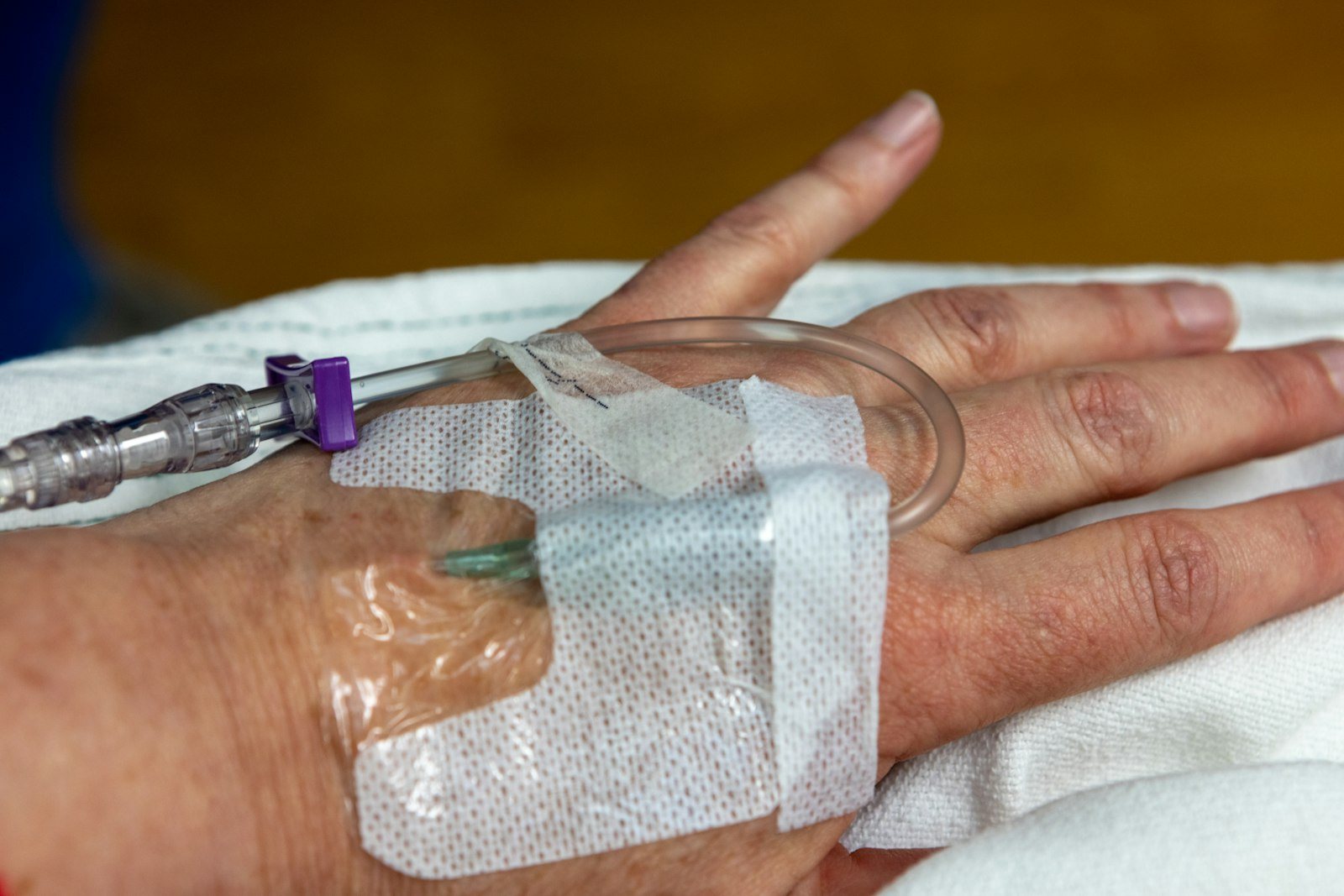
    For a short course, a cannula in the hand or forearm is placed at each visit and removed before you leave.

    For a one-off or short course, a cannula goes into a vein in your hand or arm, is used, and comes out before you go home. It is the same as having blood taken, held in place with a dressing.

    For a course running weeks, a longer-term line is usually placed instead — often a PICC line, threaded from a vein in the upper arm to a larger vein near the heart. It stays in for the duration, which spares your veins and makes each visit quicker. Our article on outpatient IV antibiotics covers living with one, including keeping it dry and what to watch for.

    A cannula and a longer-term line, compared
    Cannula in the hand or armPICC or other long-term line
    Used forA single dose or a few daysCourses running weeks
    PlacedAt each visit, in a few minutesOnce, as a short procedure with imaging to confirm position
    Comes outBefore you go home each timeAt the end of the course
    Each visitIncludes finding a vein againQuicker; the line is simply connected
    At homeNothing to look afterKept dry and covered; dressing changes
    Watch forPain or swelling at the siteRedness, swelling or fever, which need same-day advice

    Which one you get is decided by how long the course will run, not by how ill you are. Nobody has a PICC line placed for a single dose.

    During the visit

    An intravenous drip with a nurse in the background
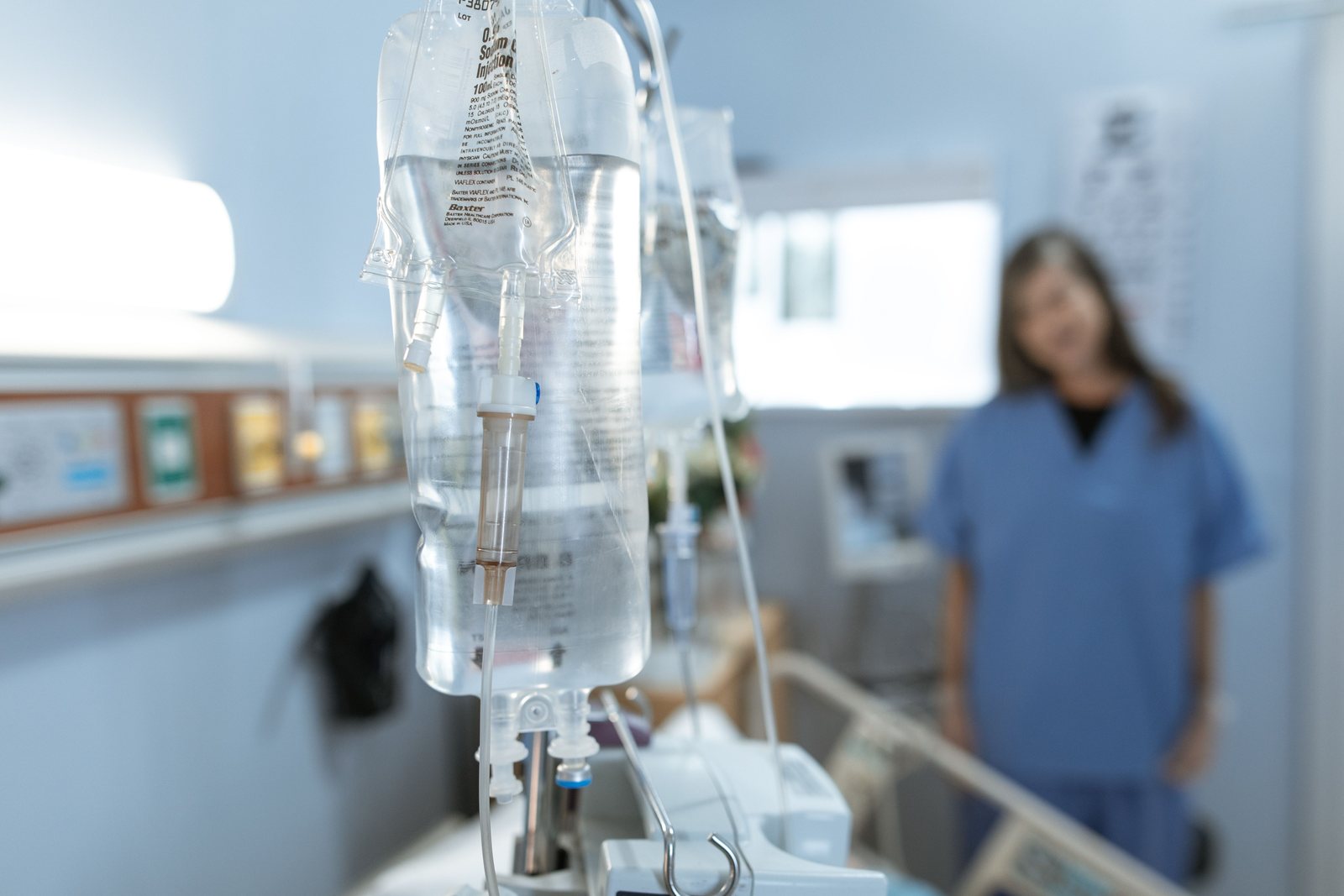
    The drug runs on a pump at a set rate; most of the appointment is simply waiting for it to finish.

    Your observations are checked, the drug is prepared, and the infusion is started, usually running through a pump at a controlled rate. Then you sit. Depending on the drug this is anywhere from thirty minutes to several hours.

    • You can read, work, use a laptop, sleep, or talk
    • You can usually eat and drink during it
    • You can go to the bathroom — the pump comes with you on a stand
    • A nurse will check on you periodically and record observations
    • The first dose is often watched more closely than later ones

    Tell the nurse straight away about anything that feels off — itching, flushing, a tight chest, a strange taste, or pain at the drip site. Most of these are minor and settle by slowing the rate down. All of them are easier to manage early.

    People frequently ask whether they can bring someone. Usually yes, and for a first visit it is worth it — an infusion is a long, quiet appointment and the company helps more than the practical assistance does.

    Side effects, and the ones that matter

    Most infusions are uneventful. The common complaints are a cool sensation up the arm, a metallic taste, mild nausea, or tenderness at the drip site.

    • Pain, swelling or redness at the drip site, which may mean the cannula needs resiting
    • Itching, a rash or flushing, which can indicate a reaction
    • Tightness in the chest or throat, or difficulty breathing — tell someone at once
    • Fever or chills during or shortly after the infusion
    • Diarrhea developing during or after a course; see C. difficile after antibiotics
    • Redness spreading from the line site between visits, which needs same-day advice

    A recorded penicillin allergy is worth resolving before a long course rather than during one, because it often forces a second-choice drug with more side effects.

    Afterwards, and the rhythm of a course

    After a first infusion you may be watched for a short period, then you go home. You can usually drive yourself unless you were given something sedating or told otherwise.

    A long course settles into a rhythm quickly: same chair, same staff, blood tests at intervals to check kidney function and blood counts, and periodic review of whether the treatment is working. Those blood tests are why courses are safe to run for weeks.

    The practice has its own office infusion center, so treatment that would otherwise mean a hospital visit happens here. You can reach us through the contact page.

    Frequently asked questions

    How long does an infusion take?

    Anywhere from about thirty minutes to several hours depending on the drug. The first visit is usually the longest, because of the paperwork, the line and a period of closer observation. Ask in advance so you can plan the day.

    Does it hurt?

    The needle going in feels like having blood taken. The infusion itself should not hurt. Pain at the site during the infusion is worth mentioning straight away, because it usually means the cannula needs repositioning.

    Can I drive myself home?

    Usually yes, unless you were given something sedating or advised otherwise. For a first infusion of a new drug it is worth asking beforehand rather than assuming.

    Can I eat and drink during it?

    Almost always, and you should eat beforehand. Infusions are not fasting appointments unless you were specifically told to fast.

    Will I need a line in my arm for weeks?

    Only for longer courses. Short courses use a cannula placed and removed each visit. Courses running weeks usually use a PICC line, which spares your veins and makes each visit faster.

    Sources and further reading: National Home Infusion Association — What is home infusion therapy?.

    This article is general health information, not medical advice, and it cannot account for your own history or medications. Discuss your situation with a qualified clinician before acting on anything you read here.

  • STI Screening: What a “Full Panel” Actually Covers

    STI Screening: What a “Full Panel” Actually Covers

    “I had the full panel” is one of the most common sentences in sexual health, and it almost never means what the person saying it thinks it means. There is no standard “full panel.” What you were tested for depends on where you went, what you were asked, and what you said.

    This matters because the gaps are predictable. Two of the most common infections are routinely tested only at the sites people do not think to mention.

    What a routine screen usually includes

    A typical screen for someone with no symptoms covers four infections, and it is a reasonable place to start.

    What is usually in, and what usually is not
    InfectionIn a routine screen?What it takes
    ChlamydiaYesUrine, or a swab from the relevant site
    GonorrheaYesUrine, or a swab from the relevant site
    HIVYesBlood
    SyphilisUsuallyBlood
    Hepatitis B and CSometimes, depending on riskBlood
    HerpesNo, unless there are symptomsA swab of a sore
    HPVNot as a standalone test for most peopleCervical screening, where applicable
    Trichomonas, mycoplasmaUsually only with symptomsUrine or a swab

    The herpes row surprises people most. Blood tests for herpes are not recommended as routine screening, because a positive result in someone with no symptoms is difficult to interpret and frequently causes distress without changing anything.

    The gap that matters most: where the swab was taken

    Chlamydia and gonorrhea are site-specific. A urine sample tests the genital site and nothing else. If exposure has included oral or anal sex, throat and rectal swabs are the only way those sites get tested, and a substantial proportion of infections are found there and nowhere else.

    Those swabs are not automatic. They are taken when the clinician knows to offer them, which depends on the sexual history being asked and answered. That conversation is the difference between a screen that means something and one that does not.

    If you were not asked about oral or anal sex, you were probably not tested for those sites. It is entirely reasonable to say so and ask for the swabs.

    Timing: why testing too early gives a false answer

    An hourglass standing on a table
    Each infection has a window between exposure and the point a test can detect it.

    Tests do not detect an infection the moment it is acquired. They detect either the organism once there is enough of it, or your antibody response once it has developed. Both take time, and the interval differs by infection.

    • Chlamydia and gonorrhea are usually detectable within one to two weeks
    • HIV tests vary by generation; modern tests detect most infections within a month, and confirmation at three months is still standard practice
    • Syphilis may take up to twelve weeks to become reliably detectable; see why syphilis testing matters again
    • Hepatitis B and C also have windows of weeks to months; see what a positive hepatitis B test means
    • A test taken the day after a specific exposure tells you about your status before that exposure, not after it

    This is why a negative result is always dated. If there has been a recent exposure, the useful question is not “was it negative” but “how long after was it taken.”

    Home testing kits have made screening far easier to access, and they are a genuine improvement on not testing at all. Their limits are the same limits as any screen: a kit tests the sites you sample, so a urine-only kit leaves the same gap a urine-only clinic visit does, and a positive result still needs a clinic for treatment and partner notification.

    If something needs treating urgently, that is separate

    Screening is for people without symptoms. Symptoms change the approach entirely: discharge, pain passing urine, sores, unusual bleeding or pelvic pain are reasons to be seen now rather than to book a routine screen.

    Prevention is also a separate conversation. Our article on how PrEP works covers HIV prevention for people who test negative, and HIV treatment today covers what a positive result now means, which is very different from what most people assume.

    How often, if you have no symptoms

    Screening frequency is a risk question rather than a moral one, and the honest answer is that it depends on how many partners and what kind of sex, not on how careful you feel you have been.

    • At least once for HIV for every adult, as a routine health measure
    • Annually for anyone with a new partner in the past year
    • Every three to six months where there are multiple or anonymous partners
    • At each visit while taking PrEP, which builds screening in
    • In pregnancy, where several infections are screened as standard; see infections and vaccines in pregnancy
    • After any partner tells you they have tested positive, regardless of schedule

    Nothing on that list requires a reason to be given. Asking for a screen is a routine request and clinics treat it as one.

    Getting the most from the appointment

    A gloved technician holding a laboratory sample plate
    What the laboratory can report is decided before the sample arrives, by which sites were sampled.
    1. Say what kinds of sex you have had, including oral and anal — it determines which swabs are taken
    2. Say when the most recent exposure was, so timing can be judged
    3. Ask explicitly which infections are being tested for
    4. Ask whether throat and rectal swabs are included
    5. Ask how you will get the results, including negative ones
    6. Ask whether a repeat test is needed because of timing

    None of that requires disclosing more than you want to. It is clinical information, it is confidential, and it exists to make the test worth taking.

    Telling a partner

    Two people talking at a kitchen table
    Partner notification is part of treatment, not an optional courtesy, and clinics can do it anonymously.

    If something is found, partners from the relevant period need testing and often treatment. This is the part people dread most, and it is the part clinics are most practiced at helping with — including anonymous notification, where a partner is told they should be tested without being told by whom.

    Untreated, several of these infections cause lasting harm: pelvic inflammatory disease and infertility from chlamydia and gonorrhea, and the staged progression of syphilis. Reinfection from an untreated partner is also the most common reason a treated infection comes straight back.

    You can reach us through the contact page, and our article on when to see an infectious disease specialist covers what a specialist assessment adds where infections recur or results are unclear.

    Frequently asked questions

    Does a “full panel” test for everything?

    No. There is no standard full panel. Most routine screens cover chlamydia, gonorrhea, HIV and syphilis. Herpes and HPV are not usually included, and hepatitis depends on risk.

    Why was I not tested for herpes?

    Blood testing for herpes is not recommended as routine screening. A positive result in someone with no symptoms is hard to interpret, cannot say where or when it was acquired, and rarely changes management.

    Do I need throat and rectal swabs?

    If you have had oral or anal sex, yes. Chlamydia and gonorrhea are site-specific, a urine test covers only the genital site, and a meaningful share of infections are found only at those other sites.

    How long after exposure should I test?

    It depends on the infection. Chlamydia and gonorrhea within one to two weeks; HIV within about a month with modern tests, with confirmation at three months; syphilis can take up to twelve weeks.

    My test was negative. Am I definitely clear?

    Only for the infections tested, at the sites sampled, up to the window period before the test. A negative result the day after an exposure says nothing about that exposure.

    Sources and further reading: Planned Parenthood — STD testing: what to expect.

    This article is general health information, not medical advice, and it cannot account for your own history or medications. Discuss your situation with a qualified clinician before acting on anything you read here.

  • When a Foot Ulcer Reaches Bone

    When a Foot Ulcer Reaches Bone

    A foot ulcer that will not heal is a wound problem. A foot ulcer that has reached bone is a different problem entirely, treated for months rather than weeks, and it is the point at which most people meet an infectious disease specialist.

    The transition is quiet. There is often no new pain, because the nerve damage that allowed the ulcer in the first place also removes the warning. Frequently the only sign is that a wound which should have closed by now has not.

    What makes a foot ulcer able to reach bone

    Three things usually line up, and they are the same three that made the ulcer likely to begin with. Our article on preventing diabetic foot ulcers covers the daily practice that heads this off.

    • Neuropathy. Reduced sensation means an injury is not felt, so it is walked on until it is deep.
    • Poor circulation. Less blood reaching the foot means slower healing and less antibiotic delivered to the tissue.
    • Depth and time. The longer an ulcer stays open, the more chance bacteria have to travel down to bone.
    The sole of a bare foot
    The sole is where most ulcers start and the part hardest to see, which is why a mirror or a second pair of eyes is part of the routine.

    Circulation is worth singling out. Where blood flow to the foot is poor, an antibiotic given at a normal dose may simply never arrive in useful quantity, which is why an assessment of the circulation happens early rather than after treatment has failed. It is also why a spreading skin infection in a foot behaves differently from cellulitis elsewhere on the body.

    The signs that it has gone deeper

    None of these is proof, and any one of them is a reason to be seen rather than to wait for the next scheduled appointment.

    • An ulcer that has not healed after about six weeks of proper care
    • A wound you can see bone in, or that a probe reaches bone through
    • A sausage-shaped, swollen, red toe
    • Increasing drainage, or a change in smell
    • New warmth or swelling across the foot
    • Blood sugars that have become hard to control for no clear reason
    • Fever, though it is often absent even with established bone infection

    The absence of pain is not reassurance here. Neuropathy removes exactly the signal that would otherwise tell you something is wrong, and the most serious foot infections are frequently the least painful.

    How it is confirmed

    A patient being positioned for a scan
    MRI is the usual test when the question is whether infection has reached bone.

    The simplest test is the oldest: a sterile blunt probe is passed into the ulcer. If it reaches bone, bone infection is likely, and that finding alone changes the plan.

    1. Probe-to-bone testing at the bedside
    2. Plain X-rays, which are useful but lag behind — changes can take weeks to appear
    3. MRI, which is the most informative scan for this question
    4. Blood tests for inflammation, which help track progress more than they diagnose
    5. A bone sample where possible, which is the only way to know which organism it is
    6. Assessment of the circulation, because healing depends on it
    What each test can and cannot settle
    TestWhat it answersWhere it falls short
    Probe to boneWhether a probe reaches bone through the ulcerSuggestive rather than definitive on its own
    Plain X-rayWhether bone has visibly changedLags weeks behind the infection; a normal film proves little early
    MRIWhether bone and surrounding tissue are involved, and how farHarder to interpret where there is prior surgery or hardware
    Inflammatory blood testsWhether inflammation is rising or settlingRise for many reasons; better for tracking than diagnosing
    Bone sample and cultureWhich organism it actually isRequires a procedure, and is falsely negative if antibiotics started first
    Wound surface swabWhat is growing on the surfaceFrequently not the organism infecting the bone

    That last row is the one worth arguing about with anyone who offers a swab as the answer. Surface bacteria and bone bacteria are often different organisms, and treating the wrong one wastes weeks.

    That bone sample matters more than it sounds. A swab of the ulcer surface grows whatever lives on the surface, which is often not what is infecting the bone. Our article on culture and sensitivity results explains why the sample decides what the report can tell you.

    Treatment: antibiotics, surgery, or both

    Bone infection in the foot is treated for weeks, and the reasons are in our article on why some antibiotic courses run for weeks. Six weeks is common, often starting intravenously.

    Surgery is not a failure of the antibiotics. Removing infected bone can shorten the antibiotic course considerably and improves the chance of healing, and in many cases the two are planned together from the start.

    • Antibiotics alone, where the bone infection is limited and circulation is good
    • Removal of infected bone, which can shorten treatment substantially
    • Restoring blood supply, sometimes before anything else can work
    • Offloading — casts, boots or special footwear, so the ulcer is not walked on
    • Regular wound care and debridement; see why some wounds do not heal
    • Amputation of a toe or part of the foot, which is sometimes the option that preserves the most function

    Offloading is the part patients most often underestimate. An ulcer on the sole will not heal while it is being stood on, however good the antibiotics are.

    What the months afterwards look like

    A clinician examining a patient's foot with medical equipment
    Follow-up is regular and long, because recurrence is common and early recurrence is manageable.

    Recurrence rates after a healed diabetic foot ulcer are high — a large proportion of people have another within a few years. That is not a reason for despair; it is the reason follow-up continues after healing rather than stopping at it.

    • Daily foot checks, including between the toes and the sole
    • Properly fitted footwear, and custom insoles where prescribed
    • Regular podiatry review rather than only when something is wrong
    • Blood sugar, blood pressure and cholesterol control, which affect healing directly
    • Stopping smoking, which affects circulation more than almost anything else
    • Calling early about any new ulcer, however small it looks

    Deep bone infection is managed jointly by podiatry, vascular surgery and infectious disease. Our article on when to see an infectious disease specialist explains what that part involves, and you can reach us through the contact page.

    Frequently asked questions

    How do I know if my foot ulcer has reached bone?

    You often cannot tell from symptoms, because neuropathy removes the pain that would warn you. An ulcer not healed after about six weeks, one you can see bone in, or a swollen sausage-shaped toe all warrant assessment.

    Does bone infection always mean amputation?

    No. Many cases are treated with antibiotics, with or without removing a small amount of infected bone. Amputation is considered when the tissue cannot be saved or the circulation cannot be restored.

    Why six weeks of antibiotics?

    Bone has a poor blood supply, so antibiotics reach it slowly and at lower concentrations than they reach soft tissue. Where infected bone is surgically removed, the course is sometimes shorter.

    Why does the wound swab not tell them enough?

    A surface swab grows the bacteria living on the surface, which are often not the ones infecting the bone. A bone sample gives a far more reliable answer.

    It does not hurt. Can it really be serious?

    Yes, and the lack of pain is part of the problem. Nerve damage removes the warning signal, so the most serious diabetic foot infections are often the least painful.

    Sources and further reading: American Podiatric Medical Association — Diabetic wound care.

    This article is general health information, not medical advice, and it cannot account for your own history or medications. Discuss your situation with a qualified clinician before acting on anything you read here.

  • Why One Antibiotic Course Is Five Days and Another Is Six Weeks

    Why One Antibiotic Course Is Five Days and Another Is Six Weeks

    Two people leave the same clinic on the same afternoon. One has five days of tablets. The other has six weeks of intravenous antibiotics and a line in their arm. Both have a bacterial infection, and both prescriptions are correct.

    Course length is not a measure of how ill you are. It follows from where the infection is, and specifically from how easily antibiotics reach it.

    What actually sets the length

    An antibiotic has to reach the bacteria at a high enough concentration for long enough to finish them off. Blood, urine and skin are easy to reach. Bone, heart valves, abscess cavities and anything with an implant in it are not.

    • Blood supply. Well-perfused tissue gets a high drug level quickly. Bone and old scar tissue do not.
    • Whether there is a collection. Antibiotics barely penetrate pus, which is why abscesses are drained rather than simply treated.
    • Whether there is hardware. Bacteria form a biofilm on artificial surfaces that antibiotics struggle to cross; see infection after a joint replacement
    • Which organism it is. Some grow slowly and are killed slowly.
    • Your own immune system. Where it is suppressed, the drug does more of the work and often for longer; see vaccines when your immune system is suppressed
    Why the same word covers five days and six weeks
    InfectionTypical lengthWhat drives it
    Uncomplicated urinary infectionThree to five daysThe drug concentrates in urine at very high levels
    CellulitisFive to seven daysSkin is well supplied with blood; longer if it is slow to settle
    Community-acquired pneumoniaFive days for mostShortened substantially in recent years by trial evidence
    Bone infectionSix weeks, often intravenous at firstBone is poorly penetrated and heals slowly
    Heart valve infectionFour to six weeks, intravenousVegetations on a valve have almost no blood supply
    Infection on an implantSix weeks, sometimes months afterBiofilm on hardware resists antibiotics at any dose

    The pattern is consistent: the harder a site is to reach, the longer the course. Nothing in that table is about the severity of how you feel.

    Shorter has become the rule for common infections

    For a long time, course lengths were round numbers inherited from custom rather than evidence — seven days, ten days, fourteen. A large body of trials has since compared shorter courses against longer ones for common infections and found them equivalent.

    So a five-day course for pneumonia is not your clinician being sparing. It is the current standard, and the longer course it replaced was never shown to be better. Shorter courses also mean fewer side effects, less C. difficile diarrhea and less pressure toward antibiotic resistance.

    If you have been prescribed a shorter course than you expected, that is usually evidence catching up with habit. If you have been prescribed a much longer one, there is a reason rooted in where the infection is — and it is worth asking what that reason is.

    So should you still finish the course?

    An assortment of blister-packed tablets
    Feeling better in three days is expected. It is not the same as the infection being finished with.

    This is where public messaging has genuinely shifted, and the shift is easy to misread. The old instruction — always finish every tablet — was built on a belief that stopping early breeds resistance. That specific claim turned out to be weaker than it sounded.

    What replaced it is not “stop when you feel better.” It is that the right length should be prescribed in the first place, and then taken as prescribed. You are not in a position to judge from home whether a deep infection has cleared, because feeling better happens well before the bacteria are gone.

    • Take the course you were given, to the end
    • If side effects are the problem, call rather than simply stopping — there are usually alternatives
    • Do not save leftovers for next time, and do not take someone else’s
    • Do not ask for a longer course “to be safe”; longer is not safer
    • If you are not improving by 48 to 72 hours, that is a reason to be reassessed rather than to continue hopefully

    When the course runs into weeks

    A radiologist reviewing X-ray images on a screen
    Long courses are usually monitored with repeat imaging and blood tests rather than by how well you feel.

    Deep infections — bone, joints, heart valves, implants, the spine — are the ones that run for weeks. Our articles on bone and joint infections and heart valve infection cover two of them, and when a foot ulcer reaches bone covers a third.

    Much of that treatment is intravenous, and most of it happens outside hospital. Outpatient IV antibiotics explains how that works week to week, and what an infusion appointment involves covers the visit itself.

    Long courses are also monitored differently. Blood tests track inflammation, and imaging is often repeated, because “I feel fine” is not sufficient evidence that a bone infection has resolved.

    Why the choice of drug matters as much as the length

    A shorter course of the right antibiotic beats a longer course of the wrong one. That is what a culture and sensitivity result is for, and why the drug is sometimes changed a few days in.

    A recorded penicillin allergy frequently forces a broader, less effective second choice, which is one of the strongest arguments for getting that label checked rather than carrying it for life.

    Questions worth asking

    1. How long is this course, and what decided that length?
    2. What should improvement look like, and by when?
    3. What should I do if I am not better in three days?
    4. Are there side effects that mean I should call rather than push on?
    5. Does anything else need doing — draining, removing, or imaging?
    6. Will this need to be reviewed once the culture comes back?

    Choosing the drug and the duration for a deep infection is a large part of what an infectious disease practice does. Our article on when to see an infectious disease specialist explains what that adds, and you can reach us through the contact page.

    Frequently asked questions

    Should I finish the course or stop when I feel better?

    Finish the course you were given. The messaging that changed was about how long courses should be prescribed, not about patients shortening them at home. Feeling better happens well before a deep infection is cleared.

    Why did I only get five days when I used to get ten?

    Because trials have shown shorter courses work as well for many common infections. The ten-day course was largely inherited custom. Shorter also means fewer side effects and less resistance pressure.

    Why does my infection need six weeks of treatment?

    Almost certainly because of where it is. Bone, heart valves and anything involving an implant are poorly reached by antibiotics, so the drug has to be given for far longer to finish the job.

    Can I stop early if the side effects are bad?

    Call rather than stopping. Side effects are common and there are usually alternatives. Stopping without replacing the treatment leaves the infection partly treated.

    Is a longer course safer?

    No. Longer courses carry more side effects, more C. difficile risk and more resistance, without better cure rates in the infections that have been studied. Longer is only better where the site demands it.

    Sources and further reading: American College of Physicians — Best practice advice on short-course antibiotics for common infections.

    This article is general health information, not medical advice, and it cannot account for your own history or medications. Discuss your situation with a qualified clinician before acting on anything you read here.